heynatefox.comBackNate FoxCreative Strategist
Gamma · Creative Strategist · take-home

Need a deck?just a sec.

Angle: time recoveryMeta feed and Reels3 video · 3 static · 1 note9:16 · 20.00s · scored
Download all assetsnate-fox-gamma-take-home.zip · 3 video, 3 static

A last-minute deck request lands. The reply is “just a sec.” Two seconds later, a finished deck goes back.

The joke is that “just a sec” is normally a lie, and here it isn’t.

Deliverable 1: video

Three hooks, one spine

The angle is time recovery. The Slack frame is a trigger moment, which the brief flags as retargeting only, and I agree with that read. Hooks 1 and 2 are the retargeting cuts. Hook 3 opens on the message rather than the deadline, which is the cold version of the same spine.

Hook A · Person

The Ask

Opens mid-squint, reading the message. No setup, no establishing shot. The situation is the hook. The only one that ends on a face.

Testing whether a face can earn the open without costing the middle. The brief says talking head structures hold worse, so the face gets three seconds and hands off to the scene. If hold drops against the other two, the handoff came too late.

Hook B · Situational

The Thread

A team chat with the ask already in it. The situation is not an event, it is where you are. Only the reply animates, and it holds 2.3 seconds. Ends in the same channel, two minutes later.

Testing recognition. The viewer sees a moment they have lived before the product appears. Expect the most qualified clicks.

Hook C · Title card

The Line

No product, no person. The line, big, on Deep Ocean. “Need a deck?” lands and holds a beat before it answers itself. The wordmark sits at the bottom. Closes back in the channel.

Testing clarity. States the need with no setup. Expect the lowest hold and the highest click to signup from the people who stay.

All three are judged on trial to paid, not on cheap clicks. A hook that wins CPC and loses activation is a loss.

Shared spine · 0:03–0:20
0:00–0:03The opener. Person, channel, or title card
0:03–0:14.1One unbroken product take, captions above the UI
0:14.1–0:15.8The finished deck becomes a Send button, and is pressed
0:15.8–0:18.1The reply, where each hook opened
0:18.1–0:20Need a deck? just a sec.

The middle is where their viewers leave. The spine never cuts away from the screen, so the payoff and the product are the same shot.

Deliverable 2: static

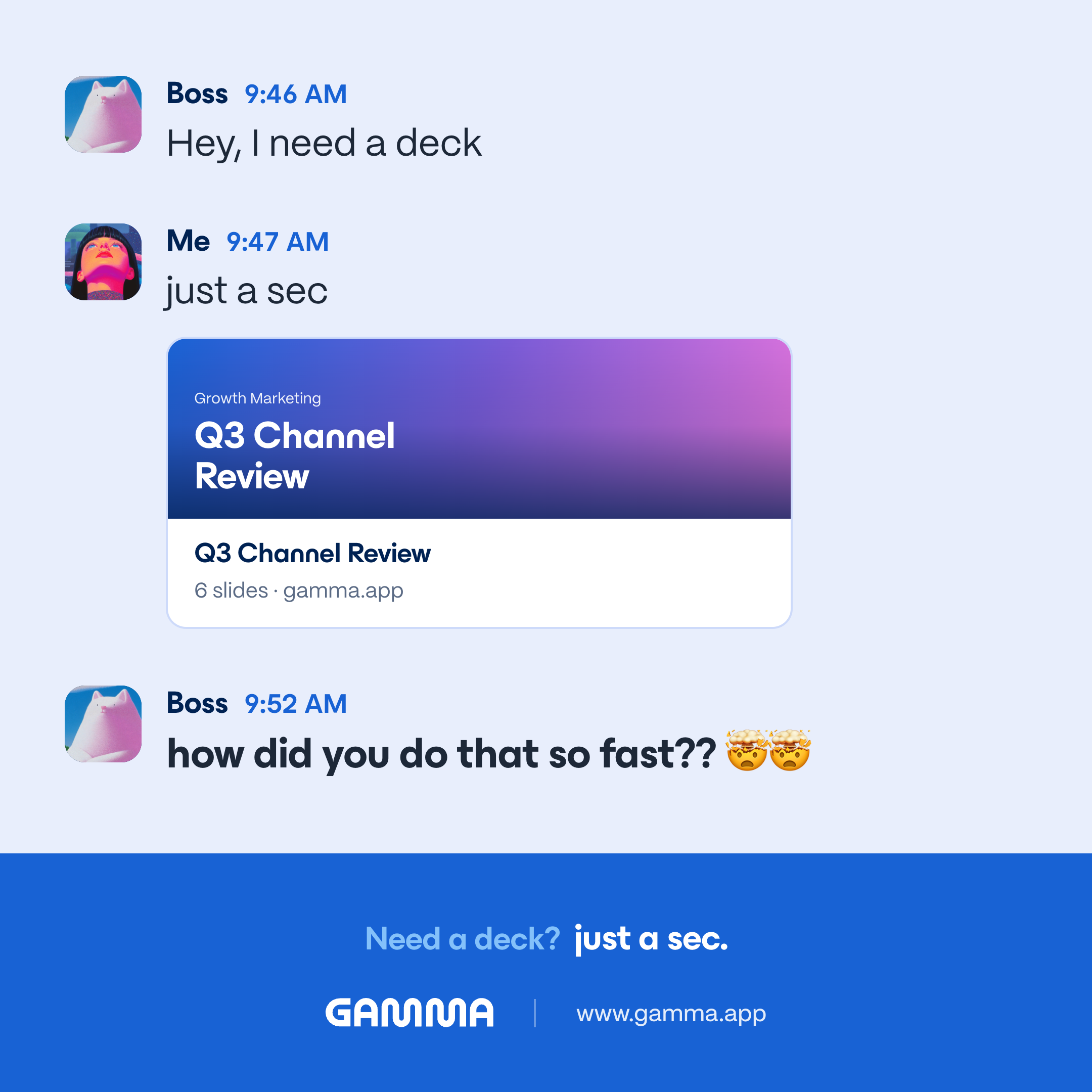
The clock makes the argument

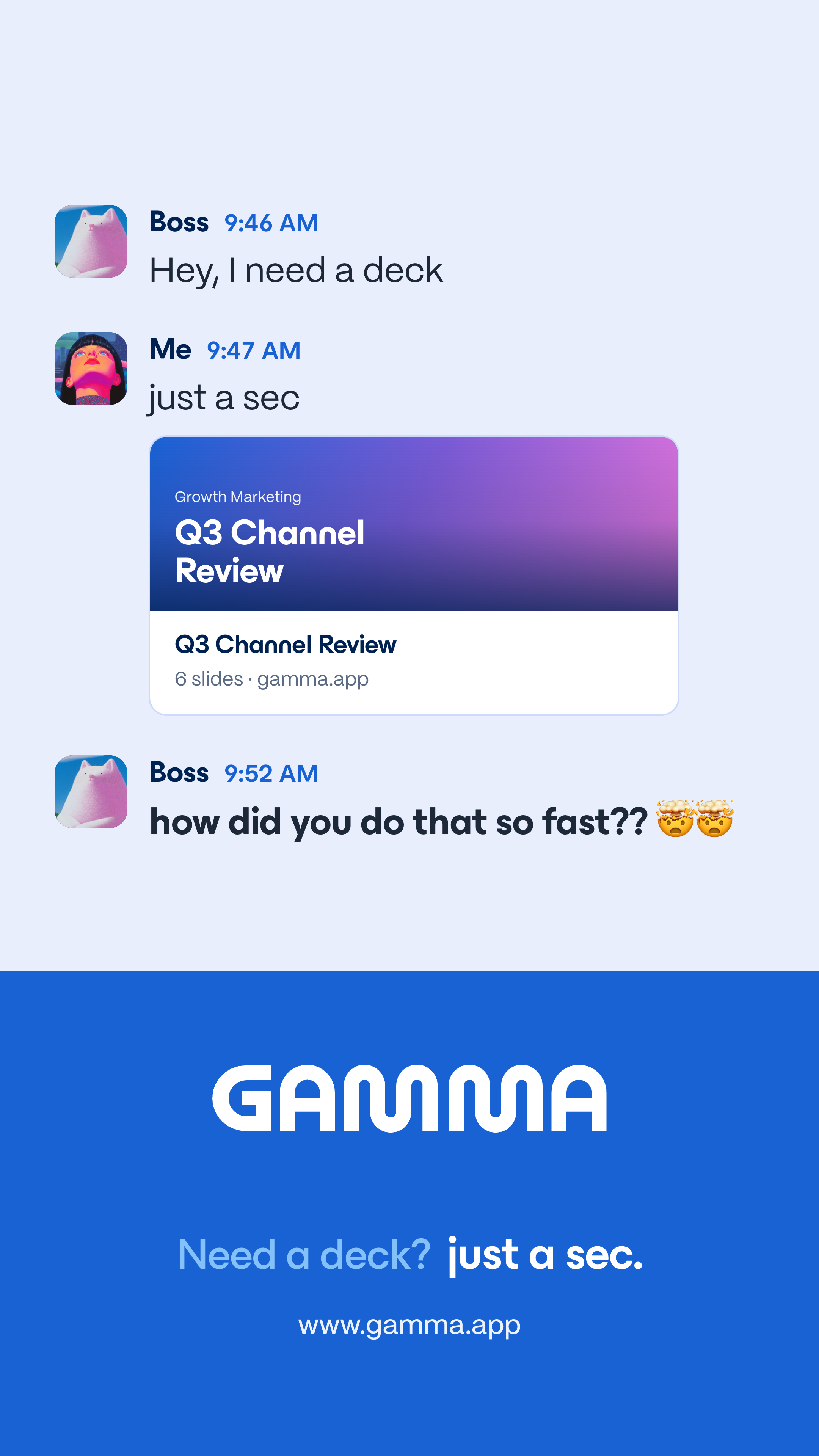
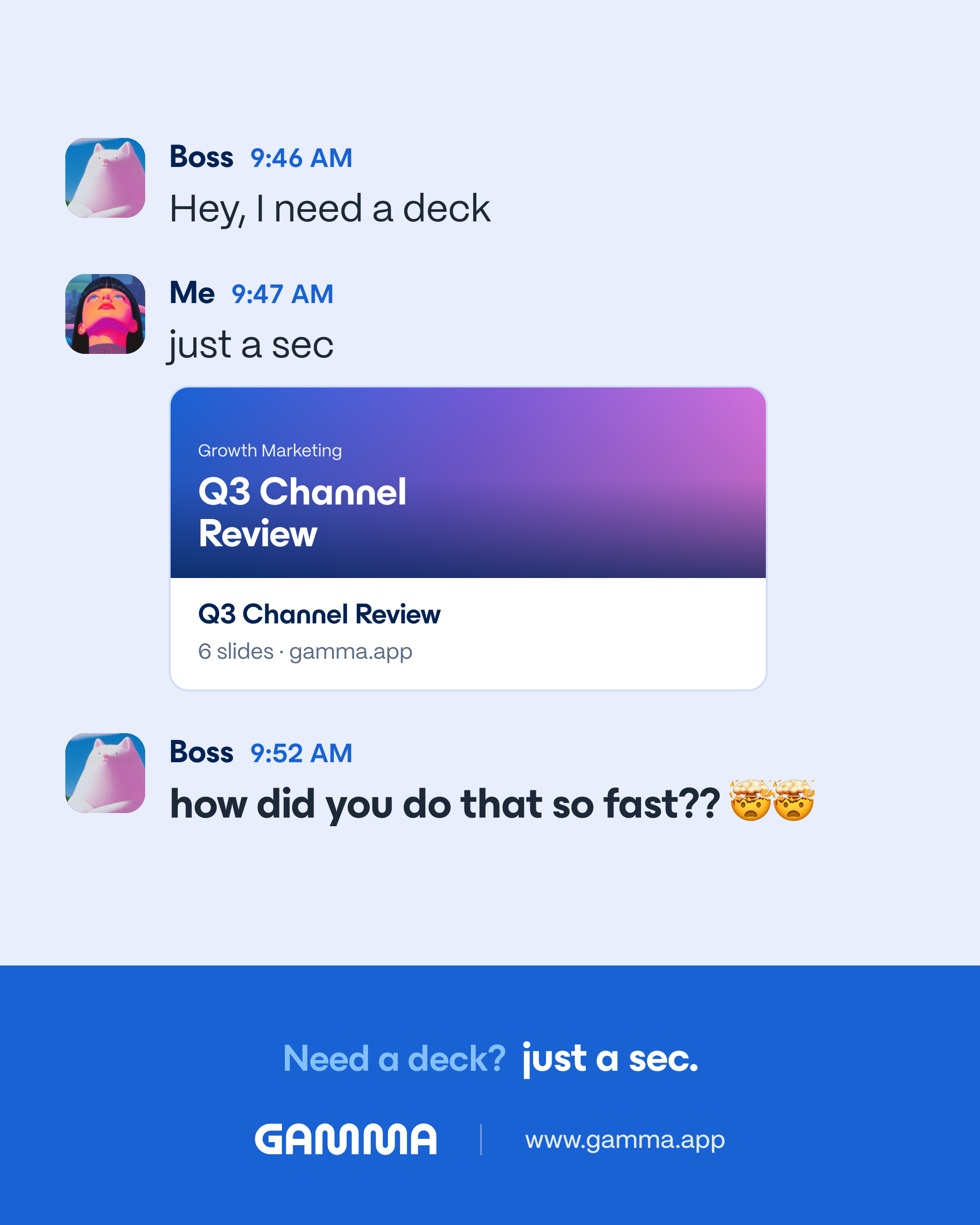
Nothing in the image claims speed. The clock does. The boss asks at 9:46, the deck lands at 9:47, and the reaction at 9:52 asks the question the viewer is already forming. Delivered at the brief’s sizes, with the wordmark held at its full clearspace of one “M”.

Chat thread: boss asks at 9:46, deck delivered 9:47, reaction at 9:52
4:51080 × 1350Feed
Chat thread: boss asks at 9:46, deck delivered 9:47, reaction at 9:52
1:11080 × 1080Feed · square
Chat thread with the Gamma lockup running to the bottom edge
9:161080 × 1920Story · Reels

Each one links to the full-resolution file. Supplied at 2× for retina placements; the trafficked sizes are the ones listed.

Download all assetsnate-fox-gamma-take-home.zip · 3 video, 3 static
Deliverable 3: process note

How it got made

I build the system first and the output second. The product UI in these spots is a build, not a screen recording, so the copy, timing, cursor path, captions and slides all live in config. The first one cost most of the time in the table below. The hundredth is a diff.

Tools, and what each one was for

Claude Code (Opus 5)The build environment. Research, asset acquisition, writing the animation engine, driving every render.
Gamma’s own product footageReference. Their CDN serves first-party 1200×950 captures of the real Generate flow, frame-sampled for exact colours, radii and spacing.
FigmaDesign layouts and pacing. Boards for the three ratios and a beat strip for the 20 seconds, so timing was settled before anything rendered.
Gamma brand book + kitCanonical palette, the −2% headline tracking rule, wordmark files.
ES Build + PP MoriGamma’s actual typefaces inside the work itself. Not lookalikes.
Custom HTML/CSS/JS engineThe UI is rebuilt as vector, not filmed. One seek(t) function describes any frame of any variant in any ratio.
Puppeteer + ffmpegFrame-exact capture and encode. H.264 for delivery; ProRes 4444 and VP9 with alpha for the layered files.

Build the pieces first

The first pass built the system, not the spot. Copy, timing, camera, captions and the slides live in one config, and the UI is built rather than filmed, so a variant is a config change and not a new edit.

That got tested mid-build. The concept changed completely: new scene, new hooks, new line, new spine. The rebuild took about 50 minutes, and the previous concept still renders untouched from its archived config. The config is the asset.

Time per piece

Research, brand and asset acquisition30 min
Animation engine: chat, title card, spine50 min
Three hook variants, 9:1610 to 15 min each
Layered alpha exports (ProRes 4444 + VP9)15 to 20 min
Statics, three ratios, layered30 min
Process note and this page30 min
Further iterations and concepts30 to 45 min
Total~3.5 hours

These three took about three and a half hours. The next thirty take one to two, because most of that time went into things that outlive the asset: the layer template, the prompt set, and the render config. A new variant changes contents, not structure. Past that point the constraint is review, not production.

Nothing ships until the benefit reads with sound off and the caption hidden, the text clears the safe area in every ratio, and the product UI matches the current build. A failed check goes back rather than shipping as a lower tier variant.

One thing the brief doesn’t account for

The brief says hold is the weak spot and hook rate is fine. If that is right, three hooks against one spine tests the part that already works. I would swap it for a 20 second and a 5 second cut of the same concept. Canva is running 5 second spots well right now. A cut that short does not need hold, it needs the idea to land immediately, and it tells you fast whether the concept survives compression before you spend on the long version.

What I’d test next

  1. How fast this story can be told. The 5 second cut of this exact concept, down to the paste and the result, against the 20. If the short one holds CPA, the long one is overhead.
  2. A 5-second cut. The mechanism resolves fast enough that 20 seconds may be longer than it needs to be. Worth finding the floor.
  3. The humor axis. This concept works on recognition, the viewer seeing their own situation. A character-led comedic version could pull much higher attention, with the risk being the CTR-without-signup pattern the brief flags as a non-performer. Worth one variant to find out.
  4. Channels past Meta. These are built for Meta feed and Reels because the brief asks for that. Discord and adjacent communities reach the same people at a fraction of the CPM, and the format here travels: the spine is a screen and a line, which is native there in a way a polished feed ad is not. I have specific placements in mind and would want to talk through them.
  5. “Just a sec” as a series. The framing extends past a single spot into episodic content about workplace time pressure, closer to brand than DR. Wrong tool for CPA, right tool for the brand layer that makes performance ads cheaper over time. I’d want to know whether that budget exists before recommending it.
Appendix

Alternate Ideas

Directions explored, not built. The one I shipped clears the three second clarity bar for cold traffic. These lean the other way, toward brand. Every angle on the performing list is pain removal, which works, and none of them test whether anyone remembers Gamma the next day. In a category getting more crowded every quarter, that is the untested axis.

01 / 05

Sexy Decksy

Dexter Lawrence is “Sexy Dexy” to every NFL fan right now. Sexy Decksy borrows the zeitgeist during season, with a talent partnership and a domain to match. Highest attention ceiling of anything here. Needs licensing, so it’s a real campaign, not a four-hour test.

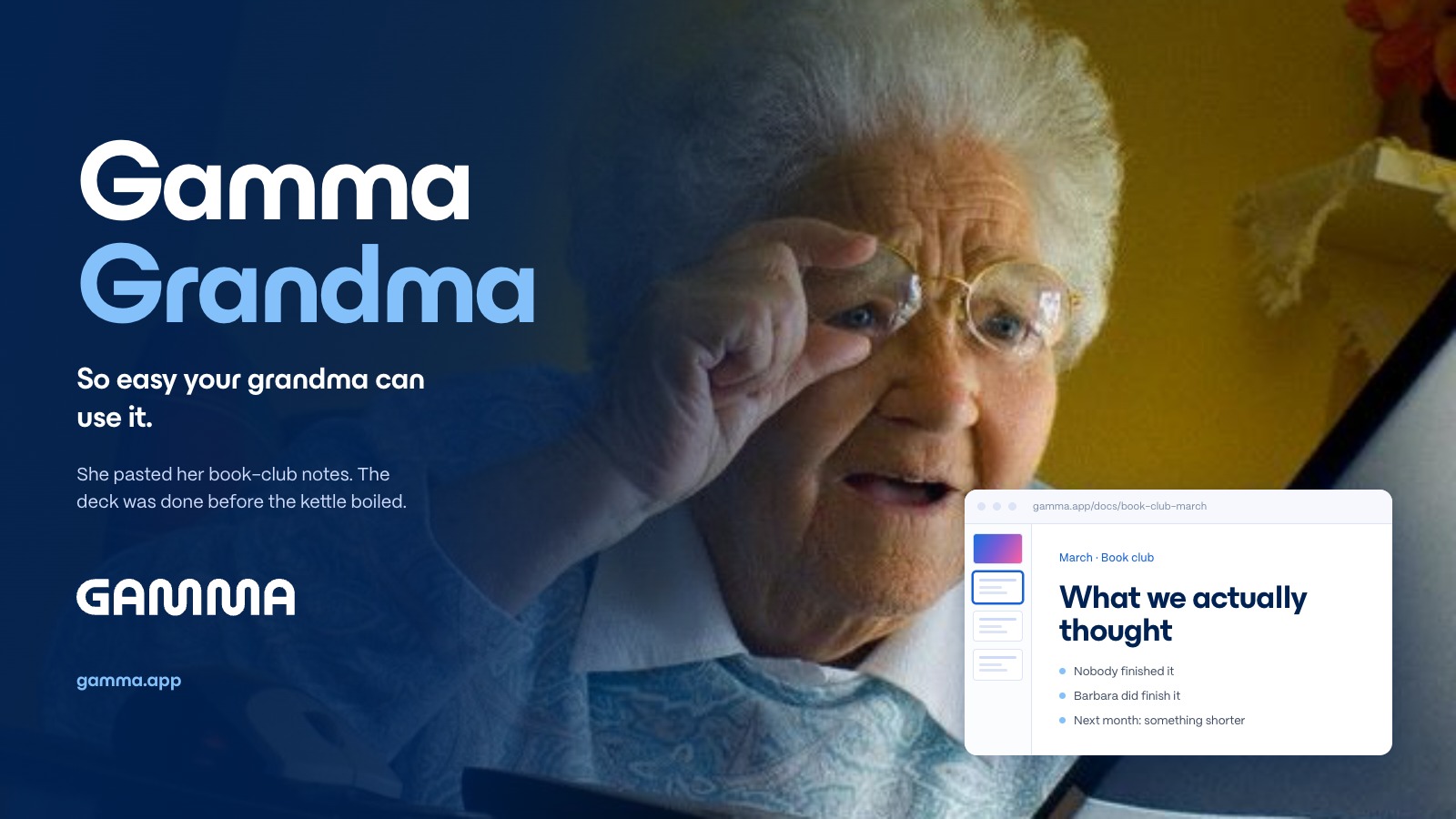
“So easy your grandma can use it” set against a finished Gamma deck
02 / 05

Gamma Grandma

“So easy your grandma can use it.” Character-led humor, tests the attention axis the main concept doesn’t touch. The risk is the pattern the brief flags: great CTR, no signups. Worth one variant to find out where the line is.

The same deck rendered flat and grey, and in Gamma’s own art direction
03 / 05

From “meh” to MEL

Magical, Expressive, Limitless is the only language in Gamma’s brand book with real heat, and it is sitting in the design system section instead of in market. Every performing angle in the brief is pain-removal. MEL is the aspiration side. Untested hypothesis: does “limitless” beat “effortless” for cold traffic?

A racing crew hiked out over the rail, every hand on the boat
04 / 05

All hands off deck

The rallying cry for an all-nighter, inverted. Nobody has to stay late. The pun carries the product benefit rather than just being clever about the category.

Just a sec: the series

05 / 05

Just a sec: the series

The framing extends past one spot into episodic content about workplace time pressure, closer to Built’s Roomies than to a performance ad. Wrong tool for CPA, right tool for the brand layer that makes performance ads cheaper over time.