Pre-Flight Compliance Checker
Built for Forterra, an autonomous defense vehicle company, during a final-round interview.
Defense marketing carries risk most marketing teams are not equipped to catch. One line in a press release can cross ITAR, OPSEC, EAR, DFARS or foreign disclosure rules, and the person writing it usually has no way to know. The safety net is legal review, which is slow, arrives late, and turns every draft into a queue.
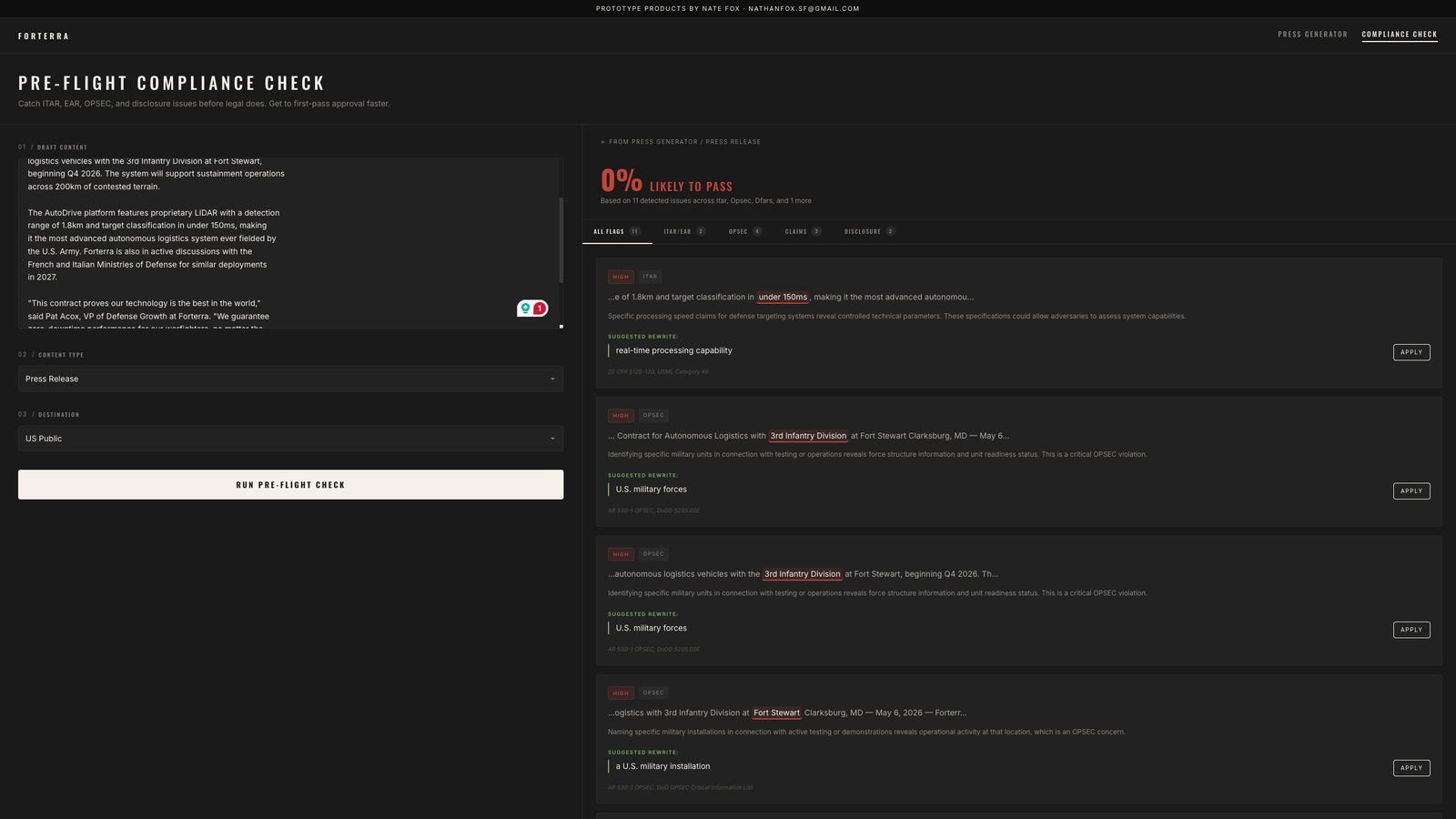
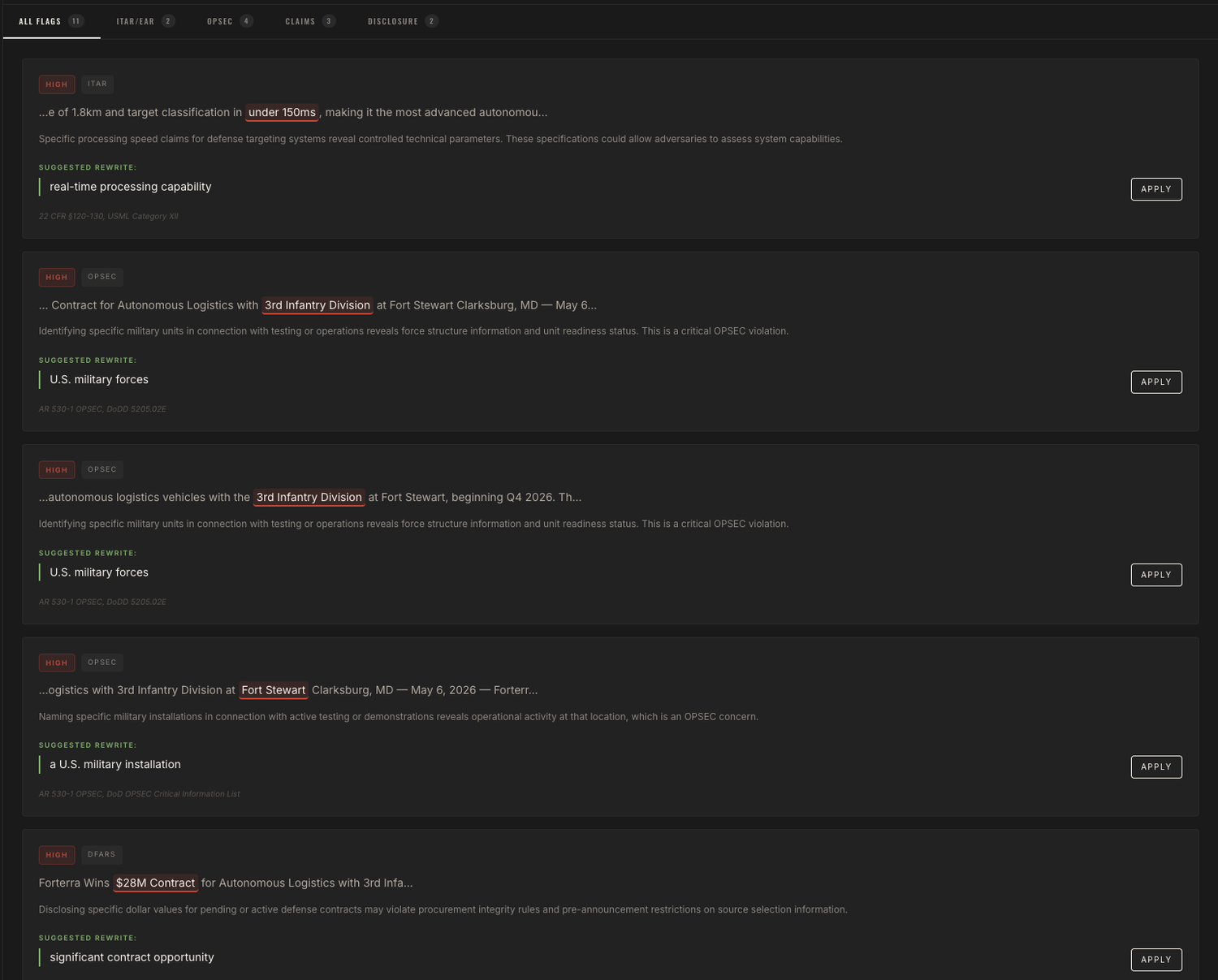
So I built a tool that reads draft marketing content and flags those problems before anything ships. Paste a draft, pick the content type and where it is going, run the check. It returns a score and every issue it found, each one carrying the exact text that triggered it, a severity, a plain explanation, the regulation it comes from cited properly, and a suggested compliant rewrite you can accept with one click. Re-run, and the score moves.
It scored clean copy at 86 to 95 percent and unfiltered drafts near zero, catching real violations on live Forterra content. It shipped as a deployed working tool rather than a mockup, and it is still running.
The rule library is the product
Anyone can build a text box that highlights words. The work was deciding what actually constitutes a violation and proving it.
Each rule pairs a pattern with a real citation. 22 CFR 120-130 and USML Category XII for sensor and targeting specifications. AR 530-1 and DoDD 5205.02E for unit identification. DFARS 252.204-7000 and FAR 3.104 for procurement integrity. 15 CFR 730-774 for dual-use characterisation.
The rewrite matters as much as the flag. Telling a marketer that a sensor range of 2.3km is a problem is half the job. Handing them extended-range sensor capability is the other half.
Attributed quotes get different treatment
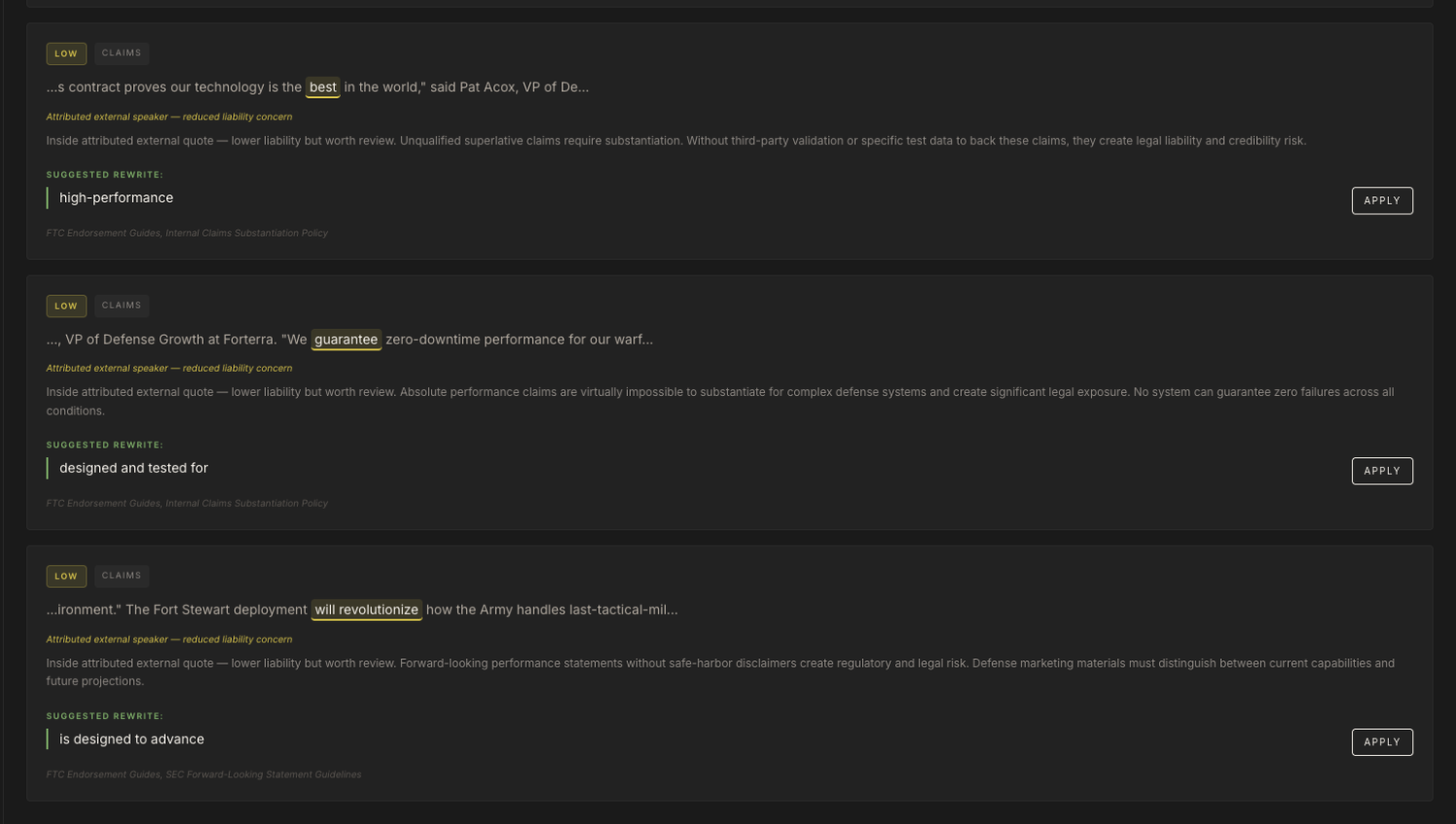
An executive quote is not the same liability as a company claim, and treating them identically would have made the tool annoying enough to ignore. The checker detects when flagged language sits inside an attributed external quote and downgrades it, marking it as reduced liability but still worth review.
That single rule is the difference between a tool a team uses and one they route around.
No model in the loop, on purpose
The checker is deterministic. A compliance tool that invents a citation is worse than no tool, because it teaches people to distrust it at exactly the moment they need it. Every flag traces to a written rule a compliance officer can read, argue with and amend.
Claude Code wrote the application. I wrote the rule library, did the regulatory research behind every citation, made the product and interface decisions, and checked each rule against the actual CFR and DoD sources.
What it changes
It turns a slow legal review bottleneck into a self-serve check anyone on the marketing team can run before they send anything. Legal still reviews, but they review drafts that have already had the obvious problems removed, with the reasoning attached.
Content types cover press release, LinkedIn post, blog, web copy, exec quote, spec sheet and trade show material. Destinations cover US public, allied NATO nations, restricted and internal only, because the same sentence can be fine in one context and a violation in another.