Make sure you’re not missing a better option.
Your headline, pointed at the two weeks when it matters most.
A plan is proposed. Treatment starts in two weeks. That gap is the whole opportunity, and it is the only window where a 24 hour report changes anything.
One moment, two people.
The segment is the treatment-decision window. A plan has been proposed, a start date exists, and in the gap between them one question sits in the room. Is this everything, or is this the first thing?
That window is short. Across 210,000 breast cancer patients in SEER-Medicare and NCDB data, 77.7% had surgery within 30 days of diagnosis. Two to four weeks is the practical window. Radical returns a report in 24 hours. That is the entire argument for this moment over any other.
Two people occupy it, and the channel decides which one you talk to. On Google the query does the targeting. On Meta you cannot target a health condition, so the creative does the qualifying, and the caregiver is the only person an ad can legally address. Roughly 43% of health information seekers are researching for someone else, and they are the ones who go online first.
The wedge: completeness, not correctness.
Correctness asks whether the plan is right. That puts Radical against the oncologist, invites a claim about treatment quality, and crosses the line the team cannot cross. Completeness asks whether the full option set is visible. It never evaluates the plan, never recommends a treatment, and positions Radical alongside the oncologist.
It is also already your headline. I am pointing spend at the position you have.
One clarification. There are two windows, not one. The other is progression or recurrence, when the standard options are running out. Diagnosis is the larger market and the cheaper place to learn what works. Progression has higher intent, one question, and a second possible payer. I built for the first and would test into the second early.
Five ads.
Two Google responsive search ads and three Meta concepts. Every line below is written to run as is.
 Radical Healthhttps://www.radicalhealth.ai options
Google RSA 1: options cluster
Creative direction. Sitelinks to Clinical Trial Matching, How It Works, Talk To A Nurse, Sample Report. Callouts for 24-Hour Report, 70,000+ Institutions, SOC 2 Certified.
Radical Healthhttps://www.radicalhealth.ai optionsGoogle RSA 2: preparation and trials cluster
Creative direction. This cluster is the cheapest inventory in the account and the most underrated. These are people who have accepted the plan and want to show up prepared. The report is exactly what they are trying to assemble by hand.
Make sure they’re notmissing abetter option.

Meta 1: the caregiver
Creative direction. The still from their own hero film behind a cream headline, with the underline on "better option" set exactly as the homepage sets it, and one plain pill above it that says what this is about. No ribbon imagery, no soft focus hands. The restraint is the trust signal, because every competitor in this feed looks like a pamphlet.
Show raw copy

“Radical really helped my mental health because I finally could quit googling.”

Meta 2: quit googling
Creative direction. Becky's real portrait, cropped the way their site crops it, with the quote in plain type beneath. This is the highest-conviction ad in the set, because it is the only one that names the feeling the product actually removes.
Show raw copy
Compare your options
One diagnosis. Every treatment option that fits it, side by side.
Make sure you’re not missing a better option.
Meta 3: the trial gap
Creative direction. The three option cards lifted straight out of the real report, stacked and simplified to what a phone shows, signed off with the headline the whole set shares. The trial statistics carry the primary text and the link headline. This ad is aimed at a later moment than the other four, progression rather than diagnosis, and it is here deliberately as the bridge into the next test.
Show raw copy
What is not in any of these: no countdown, no "don't wait", no urgency device of any kind. The urgency is already in the room. Manufacturing more of it is the fastest way to lose this audience permanently. Calm is the differentiated position in a feed full of people shouting at sick people.
The landing page.
radicalhealth.ai/options. All five ads point here.
Every cancer treatment option for your case, compared side by side, with matched clinical trials. In plain language, in 24 hours.
This is what arrives. Every option for one case, side by side, sources cited.
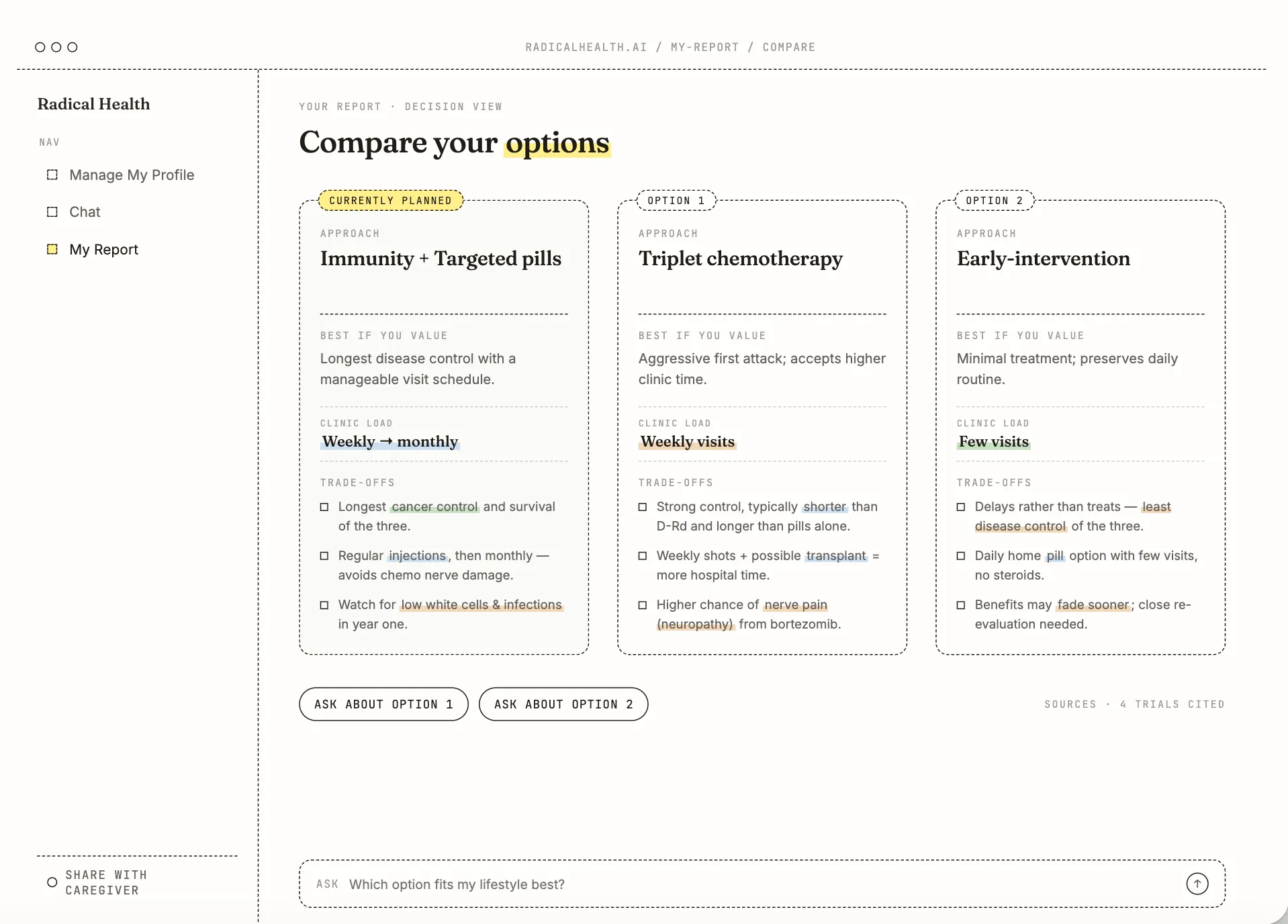
- Every cancer treatment option for your case, compared side by side.
- Trials matched from 48,800 active studies.
- An oncology nurse who knows your case, supported by senior nurses from Stanford and Dana-Farber.
NCCN guidelines define the standard of care in American oncology. Two of the people who write them shaped how these reports are built.
“Radical really helped my mental health because I finally could quit googling.”
Becky, triple negative breast cancerWe do not tell you which treatment to choose. That belongs to you and your oncologist. We make sure the conversation includes everything it should.
The playbook.
Targeting
Google Search, 65% of budget.
This is where the moment announces itself. Someone typing "questions to ask oncologist before starting chemo" has told you everything. Exact and phrase match in week one. Broad match in week two, and only against clusters that already converted.
- breast cancer treatment options
- stage 3 lung cancer treatment options
- triple negative treatment options
- her2 positive treatment options
- colorectal cancer treatment options
- what are my options after diagnosis
- alternatives to chemotherapy
- clinical trials for breast cancer
- am i eligible for a clinical trial
- clinical trials near me
- how to find a cancer clinical trial
- lung cancer clinical trials
- questions to ask oncologist
- what to ask before starting chemo
- how to prepare for oncology appointment
- understanding my pathology report
- what does my pathology report mean
- cancer second opinion
- oncology second opinion online
- remote second opinion cancer
- second opinion before starting chemo
Second opinion is underweighted on purpose. In a JAMA Oncology study of 1,901 newly diagnosed breast cancer patients, 90% never got a second opinion and 95% stayed with their first oncologist. It is the obvious cluster to build around and a much smaller market than it looks.
Prognosis and survival queries are excluded for two reasons. They convert badly, and targeting them is the kind of thing a patient would feel sick about if they ever found out. It fails the trust test even though the volume looks attractive.
Meta, 35% of budget.
Health condition targeting was removed in January 2022, so what remains is age, gender and location. Broad, 30 and up, US, one campaign, one ad set, three creatives, Feed and Reels only. The creative does the targeting. Policy also forbids implying you know the viewer's health status, which is why every Meta ad above is written about someone else. The constraint and the best strategy point the same way.
The funnel, as it actually works
- 1Ad
- 2Coverage check (3 fields)
- 3Price revealed
- 4Records connected
- 5Report in 24h
The first conversion is not a purchase. It is a three-field coverage check. The real drop is at records connection, the moment a stranger asks for access to your medical file. The landing page is built for that step: it names the records step before the click, names the 70,000 institution network, and puts the advisors and the nurse above the form. The question people are really asking is not "is this secure," it is "is this real."
Not cost per coverage check. A check with no records behind it is a generic report and a dead relationship. Coverage checks are the week-one read because they give volume fast. Records-connected is the number on the wall. An ad whose checks never connect records is buying curiosity, and it gets killed however cheap it looks.
Since we spoke I have the shape of the economics, and it changes the conclusion rather than softening it. A first paid engagement returns a couple of hundred dollars. Acquisition costs several times that today. The target is a fraction of the current number.
That gap is not a paid media problem. Good work on a badly run account might take a third off. It does not take you to a sixth. Search and Meta are how you learn which message works and what a real customer looks like. The rest has to come from channels where the marginal cost of one more patient is close to nothing, which is what the last three sections are about.
The two-week plan
- Conversion events for coverage check and records-connected firing and verified.
- Kill thresholds written down and agreed.
- UTM structure locked so cluster and creative resolve in the same report.
- Search runs the full cluster set at even weight. Meta runs three creatives against broad.
- Nothing gets touched for seven days except negative keywords, which get added daily from the search terms report.
- The instinct to optimize on day three is the most expensive instinct in paid acquisition at this budget.
- Any keyword cluster with spend above 15% of Search budget and zero records-connected patients.
- Any Meta creative below 0.8% CTR or above 2x the best creative's cost per coverage check.
- Any ad on either platform whose coverage checks connect records at under 40%, even if its cost per check is the best in the account, because it is buying the wrong person.
- The top two Search clusters to 70% of Search budget, and add broad match against those only.
- The winning Meta creative by producing three variations of its specific opening, not three new ideas.
- Meta entirely if cost per records-connected patient runs above 2x Search by end of week two, and move the budget to Search.
- Meta's job here is volume at acceptable quality. If it cannot clear that bar it is a distraction from a channel that works.
What I'd test next.
The second moment.
Everything above targets diagnosis. The second window is progression or recurrence, when the standard options are running out and the only question left is whether a trial exists. Fewer than one in ten patients ever enroll, but 55% say yes when offered. Nobody runs the search, and running the search is the product. What makes it more than a second segment is who pays. Oncology trial recruitment runs roughly $15,000 to $50,000 per enrolled patient, and screen failure rates in oncology regularly exceed 70%. A patient who has connected their records and been matched against 48,800 trials is already pre-screened, which is the exact cost sponsors are trying to avoid. Leal Health and Massive Bio both run trial matching that is free to the patient because pharma funds it. A second payer for this segment changes the math completely.
Answer-engine visibility.
People are typing "I was just diagnosed with stage 2 lung cancer, what are my options" into ChatGPT right now and getting a generic answer. That query is Radical's product, stated out loud, and nobody in this category is playing for it deliberately yet. There are real mechanics here, not more blog posts. Structured data markup raises the rate at which a model picks a page. Answers get lifted when a section opens with the direct answer instead of building to it. And citations go to sources, which means original data rather than commentary. Radical is one of the few companies here with data worth citing.
Ungate the sample report.
The biggest objection in this category is "what am I actually going to get," and the answer already exists inside the product. The sample report sits behind a login. A fully anonymized composite case, published as a page, is the most persuasive asset the company owns.
Nobody shops for this in advance.
This is a hard thing to sell, and not for the usual reasons. Nobody researches cancer reports before they need one. The need appears without warning, it lasts two to four weeks, and inside that window you are asking someone to hand a company they have never heard of access to their medical file.
You cannot build that much trust in two weeks, so the name has to be familiar before the moment arrives. That makes awareness a prerequisite for the paid channel, not a luxury above it. Binet and Field put the efficient mix near 60% brand and 40% activation. The plan above is 100% activation, which is right for two weeks and wrong for a year.
- 01
Use the credibility you already paid for.
Radical is in the Mayo Clinic Platform_Accelerate cohort, announced by Mayo. The reports were shaped by oncologists who sit on NCCN committees. Both facts are on the site and neither one leads. In a category where the only real objection is whether this is real, that is the cheapest awareness asset available and it is already bought.
- 02
Publish what only you can publish.
Radical searches 48,800 trials and reads patient journeys at volume. Findings from that data are citable in a way that blog posts are not, which earns press, earns links, and earns the AI citations described above. It is also the honest version of thought leadership, because there is actual data underneath it.
- 03
Reach wide, because you cannot predict who needs it.
For most products there is a wrong audience. Here the buyer is defined by somebody else's diagnosis, so there is no way to know in advance who will need this and no way to reach them in time once they do. That makes cheap broad reach worth more in this category than in almost any other.
Getting patients to bring patients.
In healthcare you cannot pay for a referral. Not the patient, not a partner, not per signup. The federal Anti-Kickback Statute reaches anything a federal program might pay for, and state all-payor laws apply even with no insurance involved. California bars compensation for referring patients and applies it to everyone in the chain. Paying only for non-federal patients does not work either.
So the obvious ideas are all dead on arrival. A referral fee. A free report for sharing. A gift card from a partner brand. Gift cards count as cash, and anything given to a patient has to stay under roughly $15 an item and $75 a year to avoid the question entirely.
Three things survive, and the last one is the one that scales.
Give them something worth passing on, and pay nobody.
At the moment the report is delivered and the nurse call is finished, offer the patient a plain guide to the first two weeks, written by the nurses, with Radical named on it. No money moves, so there is nothing to review. It routes through the only thing in oncology that carries real trust, which is one patient telling another, and it reaches people in week one, which paid deliberately does not.
If something has to come back to the patient, make it a donation.
They share, Radical gives to cancer research in their name. The patient receives nothing of value personally, so it is not remuneration and there is no inducement to analyze. It is also the only reward that matches the reason a person would share this in the first place. Nobody forwards a cancer report to a friend to earn a dinner reservation.
Pay institutions for work, never for referrals.
A flat fee, agreed in advance, that does not move with volume. Pfizer funds a dedicated mentor program at Imerman Angels. Komen runs patient navigation with AstraZeneca. Labcorp took equity in Outcomes4Me and promotes it on screens where patients are already sitting and waiting. Same structure every time, and all of it reaches patients at the moment of need without buying a single impression.
The pattern across all of it is that nobody pays the patient. Everybody is paid by the best funded party in the chain, and in oncology that is never the person with cancer. The one exception worth testing is an offer for the person being referred, publicly advertised and available to anyone, because an offer open to everybody is pricing rather than an inducement.
I am not a lawyer. None of this ships without yours.